Board and train program decisions are some of the most important choices you’ll ever make for your dog. Whether you’re looking for help with basic manners, obedience, puppy training, or behavior challenges, choosing the right board and train program can shape your dog’s confidence and your relationship for years to come. With so many options for dog boarding and training, it’s easy to feel overwhelmed. Every facility promises great results, but not every board and train program offers the same level of care, communication, consistency, or expertise
These are the questions every owner should be asking.
At Ducktown Lodge, we encourage people to ask difficult questions before choosing any board and train program—including ours. We believe educated owners make the best decisions for their dogs, and finding the right fit is about much more than comparing prices or reading reviews.
Here are six questions we believe every dog owner should ask before choosing a board and train program.
1. Who Will Be Training My Dog During the Board and Train Program?
If there is one question we hope every owner asks, it’s this one.
Many board and train programs have several trainers working with the dogs. Your dog may train with one person in the morning, another in the afternoon, and someone entirely different on the weekends. While that approach works for some facilities, it also means your dog is constantly adapting to different personalities, handling styles, and expectations.
Dogs thrive on consistency.
The stronger the relationship between the dog and the trainer, the more confident the dog becomes. That’s why one of the first things you should ask any dog trainer near me is who will actually be handling your dog throughout the program.
At Ducktown Lodge, your dog never changes hands.
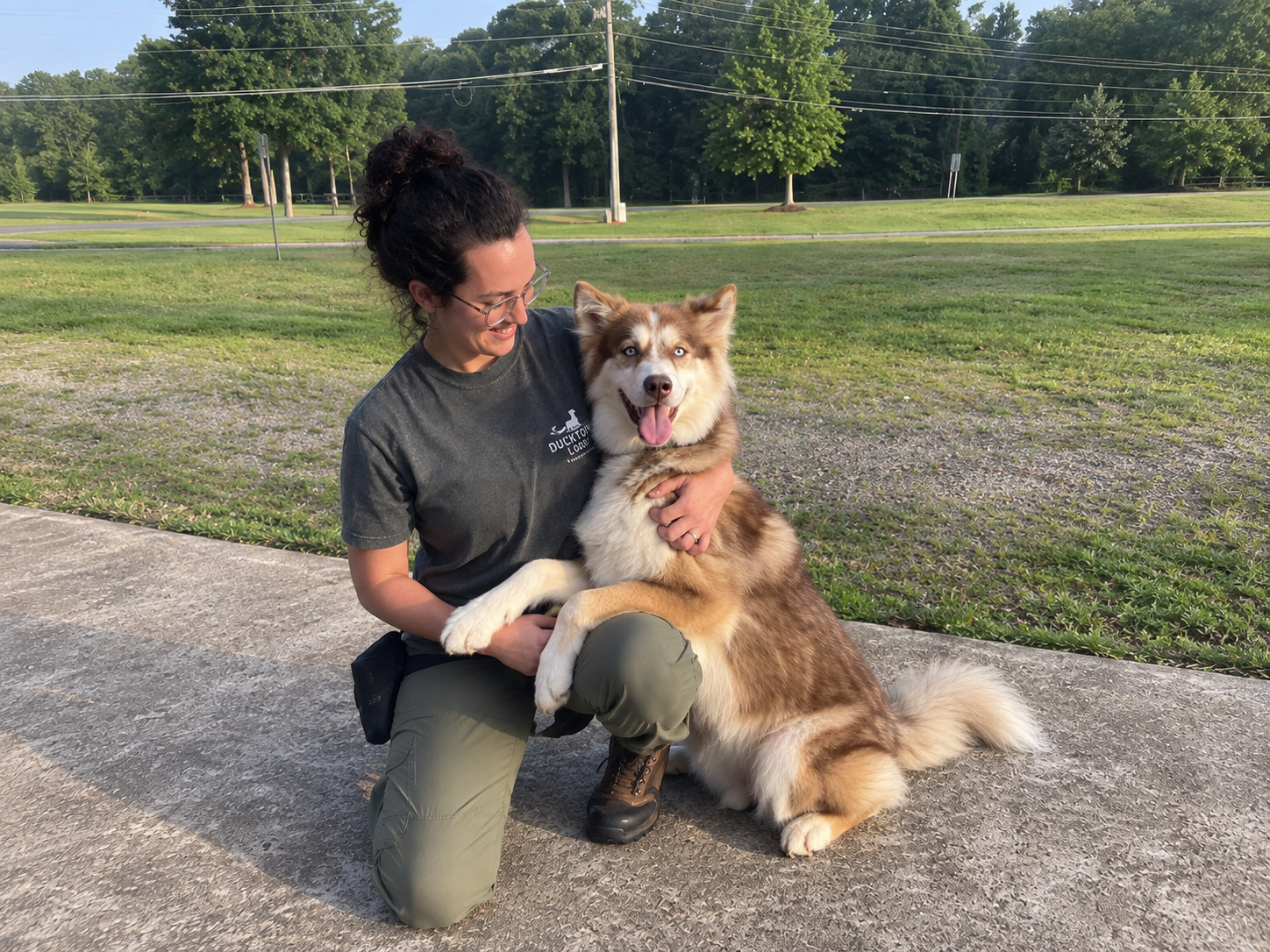
Every dog in our board and train program works directly with Lucinda York, the owner and trainer. From the day your dog arrives until the day they go home, the same experienced person is responsible for every training session, every walk, every interaction, and every milestone.
That consistency matters.
It allows trust to develop naturally, helps us recognize subtle changes in your dog’s behavior, and creates a calmer learning environment. Instead of having to earn the trust of several different trainers, your dog builds one strong relationship that carries throughout the entire board and train program.
It also means you’ll always know exactly who is caring for your dog.
You’re never left wondering who worked with your dog that day or whether everyone is following the same plan. The person answering your questions is the same person spending every day with your dog.
As you compare dog boarding and training options, don’t be afraid to ask:
- Who trains my dog each day?
- Will my dog ever be handled by multiple trainers?
- How much one-on-one time will my dog receive?
These answers often tell you far more about a board and train program than any brochure or website ever could.
2. What Training Methods Does Your Board and Train Program Use
Every professional dog trainer should be able to explain how they train dogs and, more importantly, why.
If the explanation feels confusing, overly technical, or avoids answering your questions, keep looking.
At Ducktown Lodge, we believe in balanced dog training because every dog is different. No two dogs learn in exactly the same way, and successful training means understanding the individual dog in front of you rather than applying the same formula to every situation.
Balanced dog training combines clear communication, appropriate rewards, fair accountability, and thoughtful timing. The goal isn’t simply teaching commands—it’s helping dogs understand what is expected while building confidence and trust.
Training should never feel like endless drills.
One of the biggest misconceptions about a board and train program is that dogs spend all day practicing obedience. In reality, dogs learn best through frequent, meaningful interactions spread throughout the day.
That’s why our training sessions are intentionally short and productive.
Between those sessions, dogs have opportunities to exercise, play, rest, bond with their trainer, and simply enjoy being dogs. Every walk, every interaction, and every new experience becomes another opportunity to reinforce good decisions.
Learning becomes part of daily life instead of something that only happens during scheduled lessons.
When speaking with any professional dog trainer, ask questions like:
- Why do you use your training methods?
- How do you adjust your approach for different dogs?
- How do you help owners understand the training after the program ends?
The best board and train program doesn’t just train dogs.
I3. What Does a Typical Day Look Like in Your Board and Train Program?
When evaluating a board and train program, don’t be afraid to ask one simple question:
“What will my dog’s day actually look like?”
The answer tells you a great deal about the quality of the program.
Some people picture dogs spending eight hours a day practicing obedience. In reality, that’s not how dogs learn best. Just like people, dogs need a healthy balance of learning, exercise, rest, play, and positive social interaction.
At Ducktown Lodge, our board and train program is designed around creating a calm, structured routine where learning happens naturally throughout the day.
Every morning begins with individual attention. Dogs have time to exercise, explore, and settle into their routine before beginning short, focused training sessions. Rather than drilling commands for hours, we believe dogs retain information better when training is woven into everyday life.
Throughout the day, your dog will enjoy:
- One-on-one interaction with Lucinda, the owner and trainer
- Short, productive training sessions
- Supervised exercise and play
- Bonding time that builds trust and confidence
- Mental enrichment
- Rest and relaxation between activities
Those quiet moments are just as valuable as the formal lessons.
Every walk becomes an opportunity to practice loose-leash walking.
Every doorway becomes an opportunity to reinforce patience.
Every meal becomes another chance to build calm behavior.
That’s what makes a great board and train program different from simply teaching commands.
Dogs aren’t learning to perform for treats.
They’re learning how to make good decisions throughout everyday life.
Because Lucinda personally works with every dog, she quickly recognizes when a dog needs encouragement, more structure, or simply a break. That individualized approach simply isn’t possible when dogs rotate through multiple trainers or spend most of their day in kennels.
If you’re comparing dog boarding and training options, ask to see the daily schedule.
Ask how much time your dog spends training.
Ask how much time they spend resting.
Ask how often they’re interacting with people.
A quality board and train program should focus on the whole dog—not just obedience.
4. Will My Dog Learn Skills That Work at Home—Not Just During the Board and Train Program?
One of the biggest misconceptions about a board and train program is that if a dog behaves perfectly at the training facility, they’ll automatically behave the same way at home.
Unfortunately, it doesn’t work that way.
Dogs don’t naturally generalize behavior from one environment to another.
That’s why the American Kennel Club reminds owners that continued involvement after a board and train program is essential for long-term success.
At Ducktown Lodge, we’ve always believed that the transition home is just as important as the training itself.
That’s why our board and train program goes beyond teaching obedience inside our facility.
As dogs progress, they accompany us off property to experience new environments, different sounds, unfamiliar people, and real-world distractions. We also utilize our obedience classes to safely introduce additional distractions, helping dogs practice their skills around other dogs while remaining calm and engaged.
These experiences build confidence.
More importantly, they teach dogs that the rules don’t change simply because the environment changes.
Returning home is another major transition.
Every family has different routines.
Different expectations.
Different lifestyles.
That’s why Lucinda spends extensive time preparing owners before their dog ever leaves Ducktown Lodge.
Drawing from decades of dog training experience, her work as an AKC breeder through Ducktown Retrievers, and her knowledge of the internationally respected Puppy Culture program, she helps owners understand how to continue building success at home.
That includes:
- Creating consistent daily routines
- Proper environmental exposure
- Reinforcing calm behavior
- Understanding how dogs continue learning every day
- Building confidence instead of confusion
One of Lucinda’s favorite sayings is:
“You’re either training or untraining.”
It’s a simple reminder that every interaction teaches your dog something.
Our goal isn’t simply to send home a dog that knows commands.
Our goal is to send home owners who understand how to maintain those behaviors for years to come.
That’s what separates a quality board and train program from one that focuses only on what happens during your dog’s stay.
5. How Will You Keep Me Updated During the Board and Train Program?
Leaving your dog with someone else—even for the best board and train program—can feel emotional. It’s completely normal to wonder how they’re adjusting, what they’re learning, and whether they’re happy.
That’s why communication matters just as much as the training itself.
When you’re comparing a board and train program, ask how often you’ll receive updates. Will you hear from the trainer regularly? Will you receive photos or videos? Will someone explain what your dog is learning and answer your questions along the way?
A quality dog trainer should never leave you wondering how your dog is doing.
At Ducktown Lodge, we genuinely adore keeping in touch with our clients. We know your dog isn’t “just another dog.” They’re a member of your family, and we believe you deserve to feel connected throughout their stay.
Our updates go beyond sending an occasional picture. We share your dog’s progress, celebrate milestones, explain what we’re working on, and give you a glimpse into their daily routine. Whether it’s mastering a new skill, enjoying playtime, or building confidence in a new environment, we want you to experience those moments with us.
Communication is also a chance for us to prepare you for success at home. If your dog is working through a particular challenge or making exceptional progress, we’ll talk about it. That way, there are no surprises when it’s time for your dog to return home.
Open communication builds trust.
It gives you confidence that your dog is receiving the same level of care and attention that we’d want for our own dogs.
When searching for dog boarding and training near me or the right
don’t underestimate the value of a trainer who communicates well. Knowing what’s happening each day provides peace of mind—and that’s something every dog owner deserves.
6. What Happens After the Board and Train Program Ends?
This may be the most overlooked question of all.
Many people assume that once a board and train program is complete, the work is finished.
In reality, that’s when the next chapter begins.
The American Kennel Club explains that while dogs can learn new skills during a board and train program, those skills must be reinforced at home for them to become lasting habits. Dogs don’t automatically apply what they’ve learned in one setting to every new environment. Continued guidance and consistency are essential.
At Ducktown Lodge, we’ve always believed that a successful board and train program isn’t measured by what happens during your dog’s stay—it’s measured by how well that training continues after they return home.
That’s why owner education is such an important part of our program.
Before your dog goes home, Lucinda spends time helping you understand exactly what your dog has learned and how to continue building on that success. Drawing from decades of experience as a professional trainer, her work with Ducktown Retrievers, and her knowledge of the Puppy Culture program, she provides practical coaching that helps owners feel confident from day one.
We’ll discuss:
- How to maintain structure at home.
- How to reinforce good decisions.
- How to introduce new environments successfully.
- How to continue building confidence through proper environmental exposure.
- How to make training part of everyday life.
Our goal isn’t simply to send home a dog that responds to commands.
Our goal is to strengthen the relationship between you and your dog.
As Lucinda often reminds our clients,
“You’re either training or untraining.”
Every walk.
Every greeting.
Every meal.
Every interaction teaches your dog something.
When you understand that, dog training becomes less about formal lessons and more about creating a lifestyle built on clear communication, consistency, and trust.
The American Kennel Club (AKC) reminds dog owners that a board and train program is not a quick fix. Dogs don’t automatically apply what they learn in one environment to another, which is why owner involvement and continued training at home are essential for long-term success. The AKC also encourages owners to research training methods, ask questions, and choose a program that will educate them—not just their dog.
At Ducktown Lodge, we couldn’t agree more. That’s why our board and train program focuses on more than teaching obedience. We prepare owners for the transition home with hands-on coaching, practical guidance, and ongoing support so you understand how to reinforce your dog’s training every day. As the owner of Ducktown Retrievers and an experienced AKC breeder, Lucinda York brings decades of experience raising, training, and developing dogs from puppyhood through adulthood. Combined with her knowledge of the Puppy Culture program and balanced dog training, our goal is to build confident dogs, confident owners, and relationships that last a lifetime.
Learn more from the AKC: Dog Board and Train Programs: What to Know & Alternative Options
.